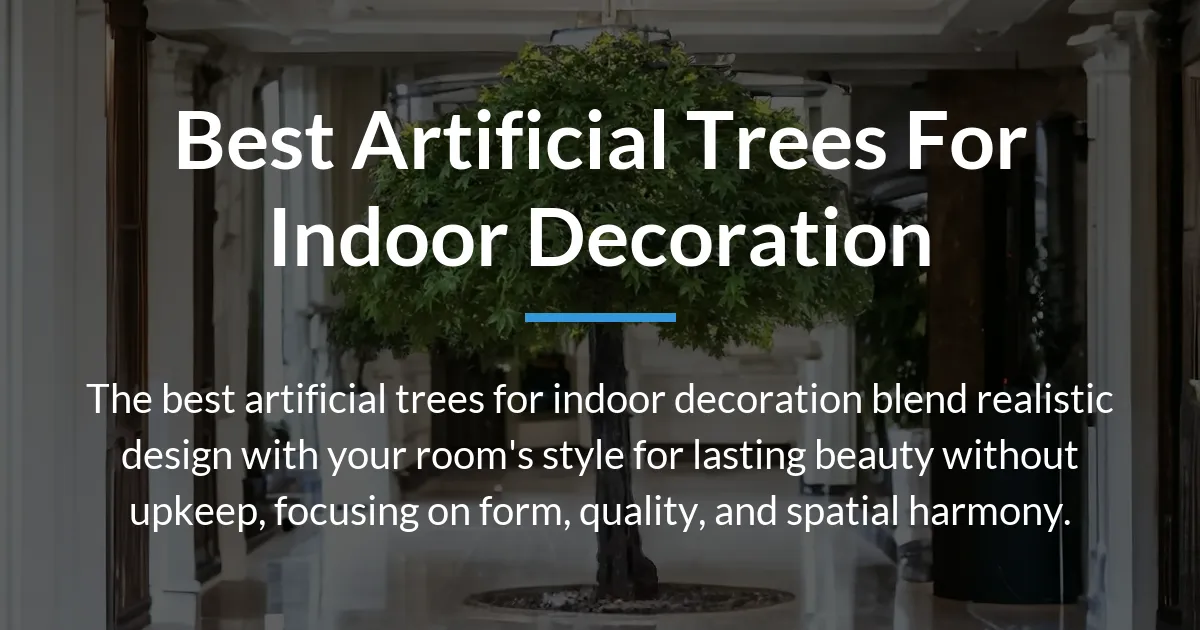
You are looking for the best artificial trees for indoor decoration because you want the beauty of greenery without any of the hassle. This is a smart choice. You are not just buying a product, you are selecting a permanent piece of your home’s design. This guide will help you choose a tree that looks incredibly real and fits your space perfectly, making your room feel complete and alive.
What Defines a Great Decorative Artificial Tree
Before we look at any specific trees, let’s understand what makes one worth buying. A great decorative tree is more than just a collection of leaves on a stick. It convinces the eye and enhances your room.
The Illusion of Life
Realism is the most important factor. A high-quality fake tree mimics nature’s imperfections. Look for texture you can almost feel, even in pictures. The leaves should have a matte finish, never a shiny plastic look that catches light in an artificial way.
Real plants are not one solid color. The best artificial trees show color variation. This includes subtle gradients from dark to light green on a single leaf, realistic veining, and even different shades on new growth versus older leaves. The undersides of leaves are often a lighter, dusty green.
Finally, examine the structure. A real tree does not grow symmetrically. Branches should curve and reach at different angles. The trunk needs believable thickness and texture, not just a thin, smooth pole.
Built to Last
Construction quality determines how your tree will look for years. A stable base is crucial to prevent tipping. Many better trees come with a weighted planter, which is far superior to a lightweight plastic base you must hide.
Check how the leaves and branches are attached. They should be secured firmly with wiring or plugs, not just glued on. A good frame, often made of bendable wire wrapped in a realistic material, allows you to shape the canopy to look full and natural.
Artificial Tree Styles and Their Design Personality
Different trees bring different moods into a room. Think of them as characters with their own style.
The Modern Classic
Fiddle-leaf figs and olive trees are favorites for a reason. They have a clean, architectural silhouette. A fiddle-leaf fig, with its large, dramatic leaves, makes a bold sculptural statement.
An olive tree, with its silvery-green leaves and twisting trunk, brings a rustic, Mediterranean calm. These trees work perfectly in minimalist, contemporary, or Scandinavian spaces where their form is the star.
The Tropical Statement
Palms and birds of paradise bring lush, vibrant energy. They have airy, spreading fronds that fill empty corners with life. A golden cane palm adds softness, while a traveler’s palm offers a striking, fan-like shape.
These trees are ideal for bohemian or eclectic rooms, sunrooms, or any space that needs a lively focal point. They suggest relaxation and faraway places.
The Structured Green
Topiaries and bonsai trees are the sculptors of the plant world. They are formal, curated, and often symmetrical. A boxwood topiary ball brings order and classic charm.
These are perfect for desks, shelves, bathroom counters, or as paired accents flanking a doorway. They add a touch of intentional, polished greenery without overwhelming the space.
Matching Your Tree to Your Room’s Decor
This is the most important step that most guides skip. The best tree for you is the one that talks to your existing furniture and style.
Considering Scale and Placement
Size matters immensely. A huge palm in a tiny apartment will feel suffocating, while a small topiary in a vast living room will get lost. Before shopping, measure your space.
For floor trees, consider ceiling height. Leave at least six to twelve inches between the top of the tree and the ceiling. Think about the footprint on the floor. A tree can be a corner anchor, filling an empty space, or a statement piece beside a sofa.
Style Synergy Examples
Use this table as a starting point to match tree types to your room’s vibe.
| Your Room’s Style | Recommended Tree Types | Why It Works |
|---|---|---|
| Minimalist / Scandinavian | Olive Tree, Ficus, Single-Stem Topiary | Clean silhouettes and muted greens add life without visual clutter or fussiness. |
| Bohemian / Eclectic | Palm, Bird of Paradise, Money Tree | Lush textures and wild, organic shapes complement layered rugs and patterns. |
| Mid-Century Modern | Fiddle-Leaf Fig, Dracaena | Bold, sculptural forms echo the iconic lines of the furniture from that era. |
| Traditional / Classic | Bay Laurel, Boxwood Topiary, Cedar | Symmetrical, manicured looks feel established and orderly, fitting a formal setting. |
How to Spot a High-Quality Artificial Tree
Now you know what style you want. But how do you judge quality from a product photo or in a store? Look past the marketing words like “Real Touch.”
The Devil in the Details
Zoom in on close-up photos. Do you see brown, textured stems that look like bark, or are they just green wires? Are the leaves all exactly the same size and shape, or is there natural variation? A realistic tree will have some smaller, younger leaves among the larger ones.
Run your eyes along the branch. Are the leaves attached in predictable, spaced-out clusters, or do they emerge in a more random, natural pattern? This attention to detail separates a convincing fake from an obvious one.
Questions to Ask Before You Buy
- Is the planter included and is it weighted? A heavy, stable base is non-negotiable for safety and realism.
- Can I adjust the branches and leaves? A bendable wire frame inside branches lets you fluff and shape the tree for a full, custom look.
- What is the trunk made of? High-quality trunks use molded plastic wrapped in a realistic material, not just painted foam.
Final Steps Before You Decide
You are almost ready to choose. These final checks will ensure your new tree fits flawlessly.
Measuring Your Space Correctly
Grab a tape measure. First, measure from your floor to the ceiling. Subtract at least one foot to find your maximum tree height. Next, use painter’s tape to mark the potential footprint on your floor. This visual box helps you see how much space the tree will truly occupy.
Finally, consider sight lines. Sit where you usually sit. Will the tree block a window or a piece of art you love? Make sure it enhances the view, not interrupts it.
The Planter Upgrade Strategy
The planter is fifty percent of the final look. Many trees come with a simple, adequate pot. To elevate the style, plan to place that entire plastic base inside a larger, more decorative planter.
This trick adds stability, allows you to match your decor exactly, and creates the impression of a mature, deeply potted plant. Just ensure your new decorative pot is wide and deep enough to hide the original base completely.
Selections for Different Needs
With your style, space, and quality knowledge in hand, here are curated categories to help you find the best artificial trees for indoor decoration.
Best for Low Light Areas
Since they don’t need real sun, any artificial tree works in low light. Focus on darker, richer greens like those of a ficus or dracaena, as they look more natural in shadowy corners than a bright, lime-green plant might.
Best Tall Trees for High Ceilings
For ceilings nine feet or higher, look for trees seven feet and above. A tall fiddle-leaf fig or a seven-foot olive tree can fill vertical space beautifully. A large areca palm or travelers palm also adds impressive height and volume without feeling dense.
Most Realistic for Focal Points
If your tree will be the main attraction in a room, invest in ultra-realistic details. Look for trees with botanically accurate leaf shapes, multiple shades of green, and highly textured trunks. These are often found in higher-end collections and are worth the price for a centerpiece you’ll enjoy for a decade.
The journey to finding the best artificial trees for indoor decoration is about blending an object’s perfect, permanent form with your own living space. It combines the eye of a designer with the sense of a smart shopper. Now, armed with an understanding of style, quality, and placement, you can choose with confidence. Bring home a tree that adds life, beauty, and a touch of effortless nature to your everyday.
Frequently Asked Questions
Can a good artificial tree be used in a bathroom?
Yes, absolutely. Artificial trees are perfect for bathrooms where real plants might struggle with low light and humidity changes. Just ensure the materials are suitable for a moist environment to prevent any damage.
How do I clean dust off artificial tree leaves effectively?
Use a soft microfiber cloth or a gentle duster. For deeper cleaning, you can use a hairdryer on a cool, low setting to blow dust away, or wipe leaves with a damp cloth. Avoid harsh chemicals.
Are artificial trees with “UV Protection” necessary for indoor use?
Usually not. UV protection is mainly for preventing color fading in direct, strong sunlight outdoors. For most indoor placements away from constant direct sun, it is not a critical feature.
What is the average lifespan of a quality artificial tree?
A well-made artificial tree, kept clean and away from direct sun, can easily last 5 to 10 years or more. The longevity is one of their key advantages over real plants.
How can I make my artificial tree smell like a real one?
You can use subtle room sprays or essential oil diffusers in the same room with scents like pine, eucalyptus, or fresh linen. Avoid spraying scent directly on the tree, as it can attract dust or damage materials.
Is it safe to put fairy lights on an artificial tree?
Yes, but with caution. Use only cool-burning LED lights, and do not leave them on unattended or for extended periods. Ensure the lights are in good condition with no exposed wires.
Why do some artificial trees look obviously fake?
Common giveaways are a shiny plastic finish, perfectly symmetrical and uniform leaves, a thin and unrealistic trunk, and branches that are too evenly spaced. High-quality trees avoid these flaws.
What should I do if my artificial tree arrives misshapen?
This is normal after shipping. Gently bend and fluff each branch and leaf into your desired shape. The wire frame inside is meant for this. It can take some time to get it looking full and natural.
Can I customize the planter that comes with the tree?
Yes, and it’s highly recommended. The best method is to place the tree’s plastic base directly into a larger, more decorative planter of your choice. This instantly upgrades the look.
Are there any eco-friendly artificial tree options?
Look for companies that use recycled materials in their construction. The most eco-friendly choice is to select a high-quality tree you will keep for many years, reducing waste from replacements.